


How Econowind helped power Terntank’s decade-long efficiency drive
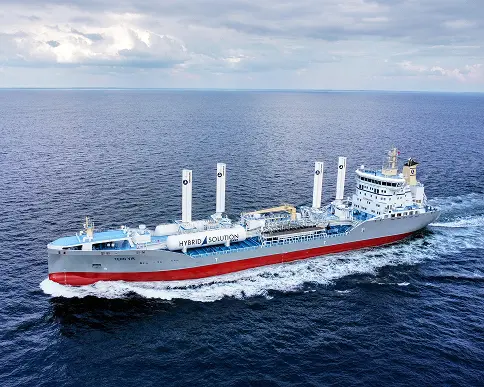
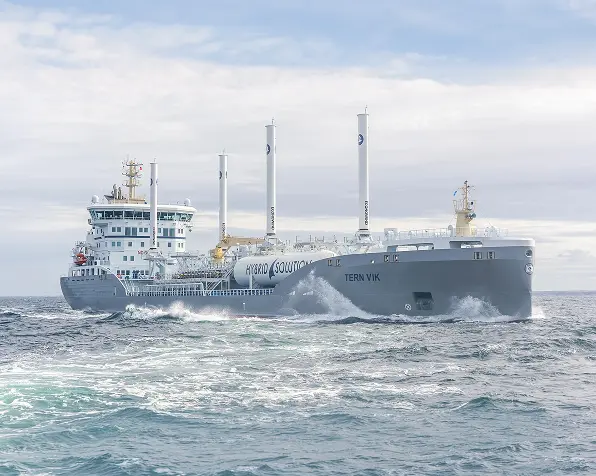
To mark ten years of developing wind-assisted ship propulsion (WASP), Dutch specialist Econowind is publishing a ten-part series highlighting the people behind its international growth, from its founder and colleagues to clients, partner shipyards, and key industry stakeholders. Telling the shipowner’s perspective is Nordic tanker owner and operator Terntank.
At the same time, Terntank is marking a milestone of its own: a decade-long efficiency roadmap that began below the waterline and has now reached the sails.
Two parallel decades
When Frank Nieuwenhuis founded Econowind ten years ago, wind propulsion was often dismissed across commercial shipping as an eccentric experiment. Today, it is widely regarded as one of the most effective tools for maritime decarbonisation. Because wind is entirely fuel-neutral, it bypasses the biggest barriers to the maritime energy transition: scarce alternative fuel supplies, volatile pricing, and a lack of port infrastructure.
For Swedish-Danish chemical and product tanker specialist Terntank, the past ten years tell a parallel story. Exactly a decade ago, the delivery of its LNG dual-fuel vessel Ternsund marked the start of a systematic efficiency drive.
For Terntank, adding Econowind’s VentoFoils was not a trial run but the logical end point of its long-term strategy.
“Our design today is the result of a journey that began ten years ago,” says Claes Möller, CEO of Terntank.
“We started with the energy efficiency of the hull, main engine, and propeller performance. Five years ago, we added batteries and shore power. Then, three years ago, we decided to add wind assistance to our next series of newbuilds.”

Claes Möller
CEO of Terntank
Always ahead of regulations
Terntank’s decision to adopt wind early reflects a long company tradition. Founded on the Swedish island of Donsö in 1958, the tanker owner has a track record of anticipating environmental regulations well before they become law.
In 1974, Terntank took delivery of its first double-hulled vessels, 12 years before the IMO’s IBC Code set stricter cargo tank protection requirements for new chemical tankers in 1986. That was also almost two decades before MARPOL Annex I made double hulls mandatory for new oil tankers in the early 1990s. In 1981, the company also pioneered vapour return systems to capture cargo gases during loading.
“It has always been our rule to stay ahead of legislation,” says the Terntank CEO.
He adds that being a frontrunner pays: Terntank’s vessels benefit from reduced port fees and lower bunker consumption.
That mindset has delivered steady gains: a 38% reduction in fuel consumption across four vessels in 2016 and 2017, followed by another 8% via batteries and shore power in 2021-2022. But once hull and battery gains were exhausted, Terntank turned to Econowind for the next major step. It selected Econowind’s VentoFoils for its newest batch of five 15,000 cbm tankers, which cut fuel consumption by more than 10%. Wind propulsion thus became the defining green technology of the Hybrid Solution Plus series, Terntank’s cleanest fleet to date.
Hybrid Solutions Plus
Applied to Terntak’s five newest 15,000 dwt tankers, the Hybrid Solution Plus concept integrated four 16-metre folding Econowind VentoFoils with methanol-ready dual-fuel engines, battery storage and shore power, cutting emissions both at sea and in port.
Built around the crew
For a company trading along the windy Norwegian coast, wind assistance was an obvious next step. However, the ice-class fleet ruled out heavy, rigid wings. The crew were consulted from the very start.
“We build vessels for our crew because they are the core of our business,” adds Möller.
“The system needed to be safe and simple.”Econowind’s automated, folding 16-metre VentoFoils proved a good fit. Terntank raised its order from three to five ships before the first newbuild left China Merchants Jinling Shipyard.
The strongest business case
While batteries and shore power handle in-port emissions, wind delivers by far the best commercial return at sea, according to Terntank.
“Wind-assisted ship propulsion systems have been definitely our best green investments so far. While shore power and batteries are essential for clean port operations, their commercial returns are constrained by high capital costs and energy tariffs. With VentoFoils, we harness free energy directly from nature and immediately save fuel across every voyage,” emphasises Möller.
EU regulations have made the financial case even clearer. Roughly half of the sails’ economic return comes from over-complying with FuelEU Maritime, alongside direct EU ETS savings. This surplus allows Terntank to offset less efficient ships through vessel pooling. Furthermore, the regulation’s wind reward factor (WRF) boosts returns beyond standard bunker savings.
Lessons at sea and the road ahead
With Tern Vik, Tern Land and Tern Dal now in service, and two more vessels arriving in 2027, performance at sea is already exceeding initial expectations. Working with Kongsberg K-Sail automation, the VentoFoils are beating their 10% fuel reduction baseline and delivering savings of 15% to 18% in favourable winds along the Norwegian coast.
Bridge visibility was an important practical consideration, particularly in high-traffic waters like the Great Belt and the Sound. When traffic tightens, the crew can easily fold down sails to keep their view clear. Terntank also decided to install an additional radar to eliminate blind spots.
From shore, Möller checks sail uptime daily via Econowind’s live platform, comparing actual fuel savings with forecasts. (to be elaborated after receiving Econowind’s input).
Looking ahead, he sees the next step as full environmental routing.
“We have integrated the wind; the next step is combining it with sea currents, weather routing, and predictive voyage planning to adjust speed dynamically and save even more fuel.”
Claes Möller
CEO of Terntank
For Econowind, marking ten years in business is about showing that wind-assisted ship propulsion belongs in mainstream commercial shipping. In Terntank, Econowind has found a partner that demonstrates that practical seafaring, mutual trust, and solid engineering deliver results at sea.
K-Sail
Developed by Kongsberg Maritime, K-Sail act like a smart cruise control for ships with sails. When the wind blows, it automatically dials back the engine to save fuel while adjusting steering to counter sideways drift.


