


How a garage experiment took wind propulsion to sea
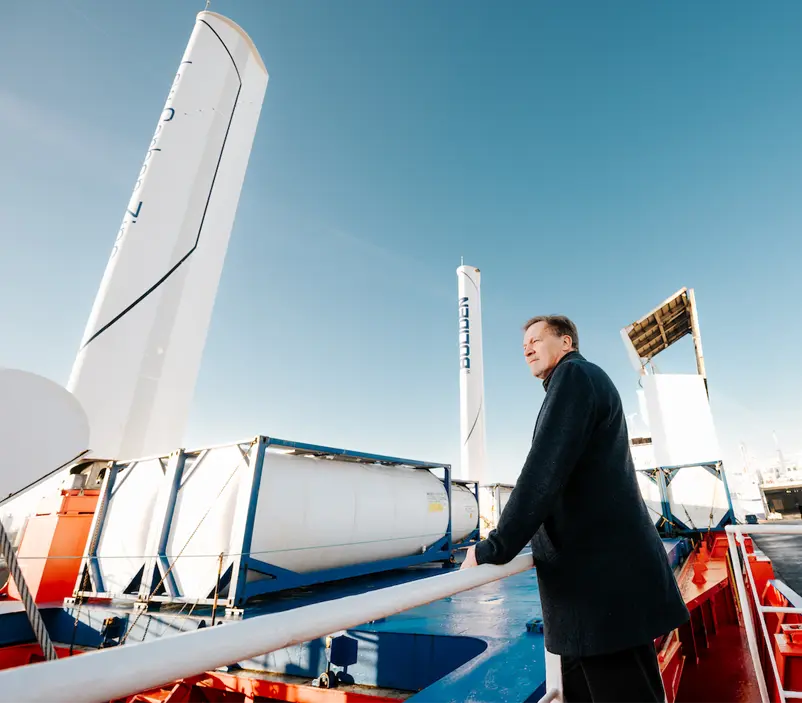
Through false starts and harsh realities of commercial shipping, one man’s persistence kept the idea alive. This is the story of how a practical experiment developed into an international maritime business.
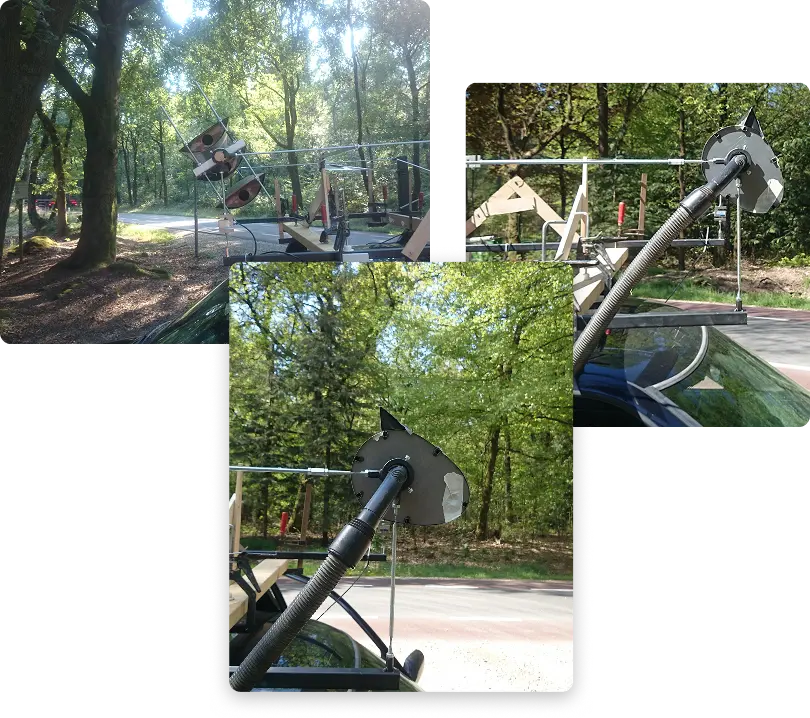
Ten years ago, Econowind founder Frank Nieuwenhuis was bolting wooden prototypes to the roof of his Saab with a vacuum cleaner on the back seat to imitate the suction effect. Today, Econowind has sold over 170 wind-propulsion systems worldwide.
From its production hall in Zeewolde, the company now supplies short-sea and deep-sea operators alike. The journey from a garage experiment to commercial shipping took a decade of trial and error.
A beer at Sneekweek
The idea that eventually became Econowind was born on the Frisian lakes during Sneekweek. This is the annual regatta where sailors race all kinds of boats by day and drink beer together afterwards, talking about their plans for the future. There, Nieuwenhuis met Guus van der Bles, the winner of the race, who said: “I want to go sail with big ships.”
Van der Bles divided his time between two roles. Four days a week he was at Groningen-based ship designer Conoship International; one day a week he was an assistant professor at Delft University of Technology (TU Delft). In his university work, Van der Bles spent his time looking ten years ahead at future ship propulsion. He figured ships needed less hull resistance and a way to use the wind blowing across the sea, which led him to Jacques Cousteau’s experiments with suction wings.
When the two men met again at the regatta a year later, in 2015, Van der Bles won the race again. Nieuwenhuis had just sold his previous company and was looking for something fun to do. Van der Bles, meanwhile, had encountered an obstacle. He wanted to test a large model in a wind tunnel, and wind tunnels cost too much money.
“Why in a wind tunnel?” Nieuwenhuis asked him. “Why don’t you put it on top of your car, drive, and measure?”
Nieuwenhuis took Cousteau’s work home, read it for a day, drew a shape in AutoCAD, and spent three weeks in his garage building that first model wing inside a frame with force sensors. Over three months he knocked together four designs on the car roof, including a triple-wing model inspired by early biplanes. A computer sat inside the car, the vacuum cleaner on the back seat ran off a generator in the boot, and Van der Bles sat in the rear taking notes as they drove.
At first, switching on the vacuum cleaner barely changed the readings. Van der Bles reasoned: the wind does not scale down with a small model. To get real suction results at that size, they would have needed seven vacuum cleaners and drive a speed of 120 km/h. The test left them with a useful conclusion: the bigger the system, the better it works.
From trailer to container and a stormy first voyage
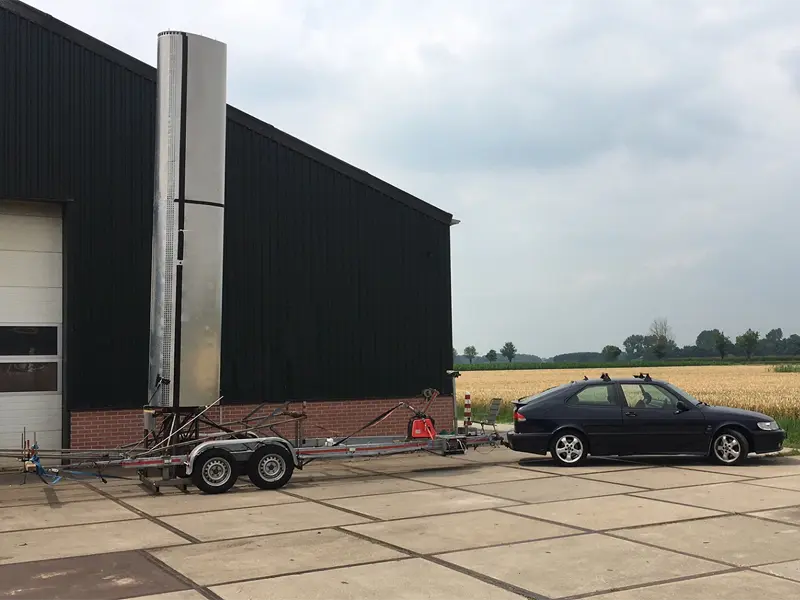
Six months later, Nieuwenhuis built a larger wing on a trailer. Standing outside his workshop, he hooked up a force sensor, switched on the generator, and watched the measured force triple. He rang Van der Bles immediately. “It is really working,” he said.
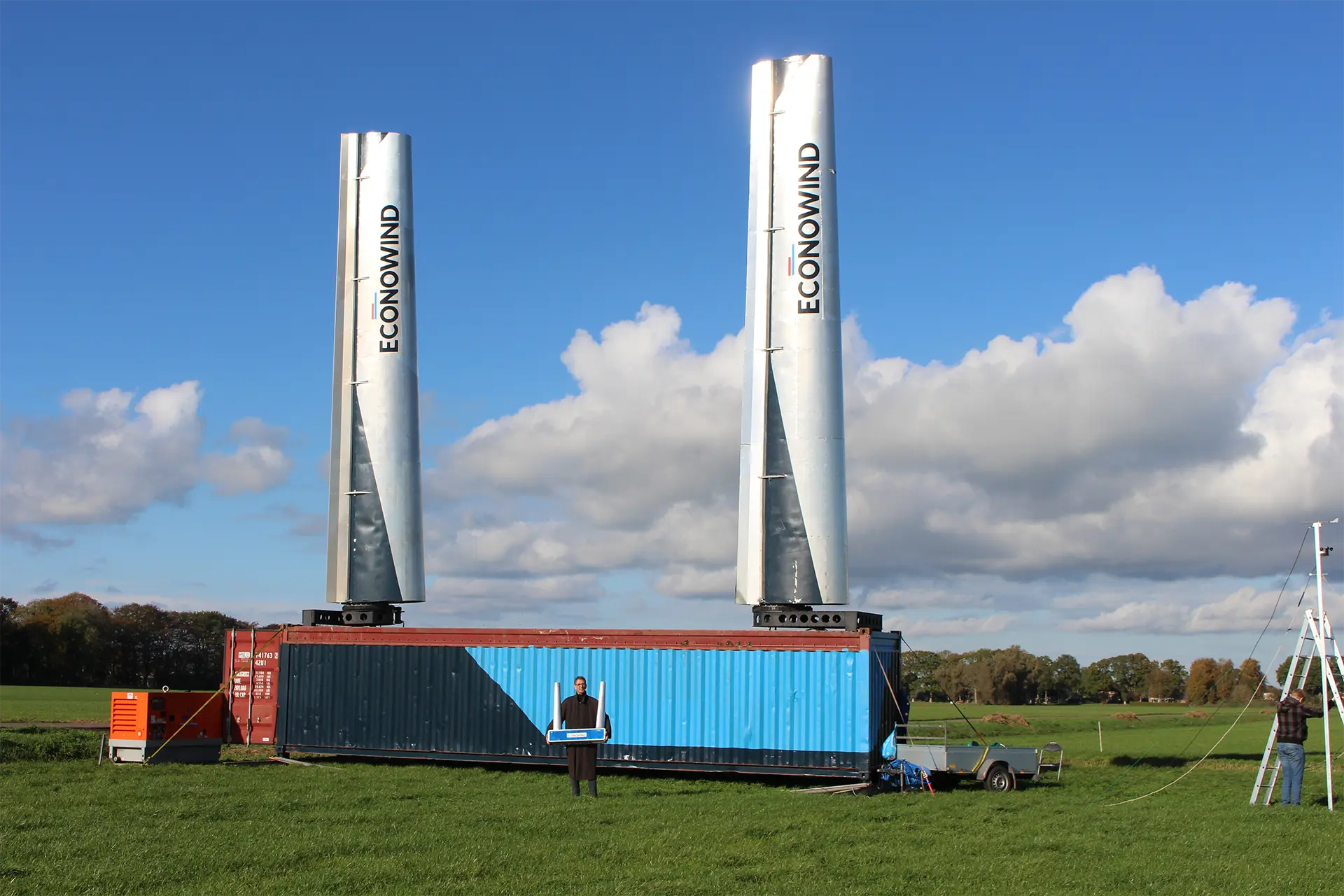
Taking a trailer prototype to sea presented a different challenge: how do you install a wing on a large enough working ship without tying the vessel up in port? They came up with the answer: build two wings inside a shipping container so the whole unit can be lifted onto a deck like any other box.
By then, garage money was no longer sufficient. Rather than draw up a contract that might end in an argument later, Nieuwenhuis set up Econowind in partnership with Conoship International.
“If the company succeeds, fine. If it goes down, we share the burden,” the partners agreed.
First, they parked the container in a field for three weeks in October, assuming autumn meant plenty of wind. Instead, they stood next to it for three weeks in dead calm.
With limited test data gathered, they put the container on a truck, drove north, and lifted it onto a Wijnne Barends cargo vessel. As soon as the ship cleared port into the North Sea, the wind hit Force 9. For nearly three days the crew could not raise the sails at all. Only when the storm eased to Force 6 or 7 did the wings finally go up at sea for the first time, watched by Nieuwenhuis’ cousin, who spent four days aboard monitoring the trial.
Pioneering is one thing, but selling is another
The trial proved the wing worked at sea. It also brought a useful reality check. While the shipowner appreciated what Nieuwenhuis was trying to achieve, he explained afterwards why an operator in his commercial position could not justify buying the system.
In tramp shipping, the owner buys the ship, while the charterer pays for the fuel. Asking an owner to pay for fuel-saving sails that cut someone else’s fuel bill is, as Nieuwenhuis puts it, like asking someone to make upgrades to a rental car.
When Nieuwenhuis suggested building two more containers to rent out, Conoship declined to invest the funds required. Its business was designing ships, not building equipment on top of them. Nieuwenhuis had to decide alone whether to walk away and write off a year without income, two employees on the payroll and his investment in the prototype, or keep going. Encouraged by Gavin Allwright, who had just founded the International Windship Association (IWSA), and an EU Interreg subsidy project in the works, Nieuwenhuis found private backing instead.
The shortest-ever investment story
After Conoship stepped back from financing two more containers, Nieuwenhuis found backing during a squash match with friend Piet Coelewij. Hearing his dilemma, Coelewij said he might know an interested investor. “Do you mean yourself?” Nieuwenhuis asked. “Yes,” came the reply. “That’s the shortest investment story ever. It took him one minute,” Nieuwenhuis laughs. Coelewij knew little about the technology, yet believed in his friend’s vision and wanted to add sustainability to his life’s work.
He began looking for shipowners who paid for their own fuel, or simply wanted to try it anyway. Early customer Jan van Dam welded steelwork and laid cables himself before the wings even arrived. That led Nieuwenhuis to think that installations were easy, until the third vessel arrived with nothing prepared at all and sat in port for more than a week. Larger operators taught him a different lesson: once finance, business development and technical teams get involved, decisions can easily take two to three years.
The solution over a cup of coffee
As the first units went into service, one part of the design needed a rethink. Following Cousteau’s concept, the early systems used a movable flap at the back that switched left or right when the wind changed sides. At sea, that moving flap needed too much servicing and looked too complicated to build in numbers.
Nieuwenhuis wrestled with ways to redesign it, thinking he would never solve the problem. Then a TU Delft master’s student ran computer simulations with the flap pointing straight back. Over a cup of coffee, they asked themselves why the flap needed to move at all when you could leave it fixed and simply reverse the direction of the internal suction fans.
“You’re working for two years and trying to optimise it, and you never think out of the box again,” Nieuwenhuis says. “It took only one cup of coffee with this guy and a few sentences that all of a sudden changed the basic setup of the product.”
He walked straight back to the trailer, took off the moving mechanism, glued the flap to the rear, and tested it again. It worked much the same. That simpler layout became today’s VentoFoil. As Econowind’s field teams gained experience and began fitting hydraulics during an earlier harbour stop, installation times came down too, eventually getting four wings lifted aboard and ready in a single day.
Letting go of the wheel
Over the past ten years, the reason shipowners buy wind propulsion has changed. In the early days, buyers were often sailors or sustainability-minded owners willing to accept a payback period of seven to nine years. Today, high fuel prices, further disruptions around the Strait of Hormuz, and IMO and EU regulations have favoured the business case for wind propulsion.
Three generations in the factory
While some owners often took two or three years to reach an investment decision, SMT Shipping moved at the speed of its founder. After hearing his sustainability manger mention wind propulsion, Mr Anthonius Voorham asked why the company did not have it yet. He put his son (SMT’s CEO) and his grandson into a car and drove straight to Econowind’s factory on Saturday. “We are a family business. That’s what we need to do,” Voorham declared. Built inside an enlarged 16-foot container welded directly to the deck of the Sunnanvik to handle heave waves off Greenland, it became one of Econowind’s most memorable early projects.
While competitors aimed straight for big ocean-going vessels, Econowind built its base in short-sea shipping, where tight decks and cargo cranes forced the wings to stay compact and practical. Working with smaller vessels gave the company valuable experience in real operating conditions, and Nieuwenhuis still sees plenty of potential in that segment. The breakthrough for Econowind came with Terntank’s CEO Claes Möller sent an email one Monday morning ordering three ships with four wings each after prolonged proper investigations and several visits back and forth. It was the step from start-up to scale-up for the company.
At the same time, he is clear that deep-sea shipping, with its longer voyages and bigger hulls is the eventual end market. Within four or five years, he expects the big wings to generate the main share of Econowind’s turnover. This is because a single 5-series VentoFoil delivers as much thrust as four 3-series units, and large ships can carry four of them on deck. Even then, smaller vessels remain part of the picture. Major fleet owners such as Nissen Kaiun operate small, medium and large ships alike, creating demand across the manufacturer’s 3- and 5-series range.
For Nieuwenhuis, the clearest sign of how much the company had grown up came about a year ago, when a photo of a new installation appeared in the company’s WhatsApp group. “Which ship is this?” he wondered. With owners now placing repeat orders for several vessels at a time, he still knows the shipping company behind the deal, just no longer every individual ship.
Now, Nieuwenhuis leaves daily operations to his colleagues so that he can focus on developing future wings. Even so, it took a visiting customer walking through the Zeewolde factory with him to make him stop and reflect.
“He actually said: ‘You must be proud.’”
“And yes, I am proud of everybody that contributed to our wind journey,” Nieuwenhuis concludes.


